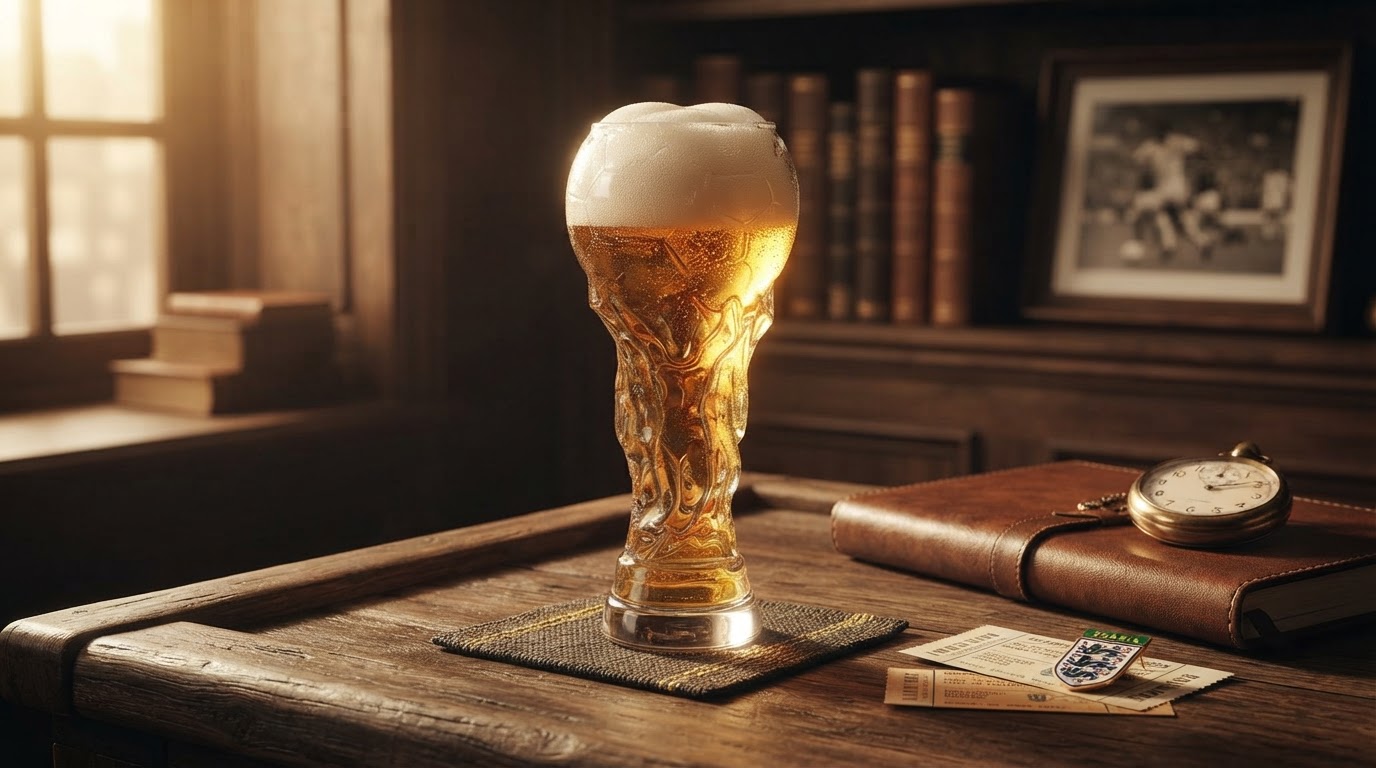
A trophy glass should pass these six checks before match day
 Priya RamanSenior Analyst
A 150 g difference in empty-glass weight is enough to change how “premium” a beer feels in the hand, even when the capacity is identical. That is the odd field observation I keep coming back to after comparing commemorative football glassware: buyers talk about the crest, the country, and the shine, but the keep-or-regift decision is usually made by the hand, the rim, and the first wash.
For a World Cup Crystal Glass, the right question is not “Is it beautiful?” Most crystal is. The better question is: will this glass still feel ceremonial after 30 uses, two tournaments, and one overloaded dishwasher?
Below is the decision framework I use when evaluating trophy-style beer glasses, football gifts, and crystal drinkware meant to be used rather than parked forever in a cabinet.
The six-part framework: ceremony, beer, and abuse
A commemorative glass has to serve three jobs at once:
That creates six checks:
- Capacity honesty — Does it hold a real serving with foam room?
- Hand balance — Does it feel stable when full, not just impressive when empty?
- Rim comfort — Is the lip thin enough to drink from, but not so thin it feels fragile?
- Base stability — Will it survive a crowded table during extra time?
- Decoration durability — Is the design protected from the habits of actual users?
- Material risk — Is the “crystal” choice appropriate for beer, gifting, and storage?
What I measured and observed across typical football beer glasses
Photo by Phát Trương on Pexels
I compared the kinds of glasses people most often buy for watch parties and football gifts: tulip beer glasses, tankards, straight-sided pints, stemmed crystal beer glasses, and trophy-inspired commemorative glasses. The numbers below are not a laboratory certification; they are practical buyer-side observations from common retail formats and sample handling.
| Attribute observed | Practical range seen | Why it matters | My preferred range for a World Cup Crystal Glass | |---|---:|---|---:| | Empty weight | 260–520 g | Heavier feels premium, but gets tiring when full | 330–430 g | | Filled weight at 500 ml beer | 760–1,020 g | Above 900 g, casual sipping feels less relaxed | Under 900 g if possible | | Brim capacity | 430–620 ml | Needs beer plus foam, not just liquid volume | 500–570 ml | | Usable pour with foam | 330–500 ml | Real serving capacity is lower than brim capacity | 400–500 ml | | Rim thickness | 1.4–3.2 mm | Thick rims dull aroma and feel less refined | 1.5–2.2 mm | | Base diameter | 55–85 mm | Wider base improves match-day table stability | 65–80 mm | | Height | 150–225 mm | Tall glasses look dramatic but tip more easily | 170–205 mm | | Engraved/printed area | 20–70 cm² | More decoration increases visual impact and cleaning risk | 25–45 cm² |
The most useful number is not capacity; it is filled weight. A 500 ml pour in a 500 g glass approaches 1 kg in the hand. That can feel impressive for the first toast and clumsy by halftime.
Check 1: capacity honesty beats oversized drama
Beer glass capacity is often advertised as if the glass were filled to the very rim. Nobody should pour beer that way. Foam matters, especially with pilsners, wheat beers, pale ales, and many lagers commonly served during football matches.
A practical rule: subtract 15–25% from brim capacity to estimate real serving capacity with foam. A 500 ml brim glass may comfortably serve 375–425 ml. A 570 ml brim glass often works better for a 440 ml can or a 500 ml bottle if you want headspace.
ISO 3591, the international standard for wine-tasting glasses, is not a beer standard, but it teaches a useful principle: sensory glassware is defined not only by volume but by shape, opening, and repeatability. In plain terms, the bowl and rim change the experience. Beer is no different. A World Cup Crystal Glass that simply maximizes volume may look generous, but a glass with controlled headspace usually drinks better.
For gift buyers, I would rather see a glass described with both brim capacity and recommended pour. If only one number is listed, assume it is brim capacity unless the seller says otherwise.
Check 2: balance matters more than empty weight
Retail photos reward heavy bases and tall silhouettes. Real tables do not.
A stable commemorative glass has a low enough center of gravity that it does not feel nervous when full. Two glasses can weigh the same and behave differently: one may carry weight in the base, the other in thick sidewalls. Base-heavy usually feels safer, but too much base weight can make the glass feel like a small trophy rather than drinkware.
Here is my at-home balance test:
If the glass feels awkward with water, it will feel worse with beer in a crowded room.
For a football gift, I like a glass that has enough mass to feel like an occasion but not so much that it becomes display-only. That usually means moderate wall thickness, a stable base, and an empty weight under roughly 430 g for a 500–570 ml format.
Check 3: the rim is where “premium” becomes real
People notice the shine first, but they judge the glass at the rim. A bulky rim makes beer feel flatter and less precise. A very thin rim can feel elegant but may be a poor match for watch-party handling.
For crystal beer glassware, I look for a rim around 1.5–2.2 mm. Below that, I start worrying about chips if the glass is going to be used around sinks, rings, and other glassware. Above about 2.5–3 mm, the glass may still be attractive, but it feels more like a souvenir tumbler than a refined drinking glass.
This is also where crystal has an advantage over many ordinary thick-walled promotional pints. Crystal can deliver brightness and a finer lip without needing the whole vessel to feel delicate. That matters if the glass is meant to be a gift for someone who actually drinks from it.
Check 4: do not ignore the base diameter
During big matches, glasses live in hostile conditions: crowded coffee tables, plates, remote controls, snack bowls, celebratory arm movements, and people standing up too fast after a goal.
A narrow base can look elegant in product photos, but a wider base is more forgiving in real rooms. I prefer a base diameter between 65 and 80 mm for most full-size beer crystal. Below that, a tall glass begins to feel easier to knock. Above that, the glass can become awkward in smaller hands or crowded cabinets.
A quick stability test at home is simple: place the empty glass on a folded tea towel and lightly tap the table beside it. You are not testing impact resistance; you are watching how readily the glass rocks. If it rocks dramatically when empty, it will not become magically graceful in a crowded setting.
Check 5: decoration should match cleaning behavior
Football glassware is often bought for the emblem: tournament styling, a trophy silhouette, a country-color motif, or a precise etched football pattern. But decoration changes maintenance.
There are three common decoration approaches:
- Surface printing: vivid and flexible, but can be vulnerable to abrasion and harsh dishwasher cycles.
- Etching or engraving: more durable visually, often subtler, and less likely to peel.
- Cut or molded relief: tactile and premium, but can catch water spots and residue.
My practical advice: if the glass carries a metallic, colored, or highly detailed World Cup design, hand-washing is the safer default. Use warm water, mild detergent, and a soft cloth. Avoid scouring pads, high-alkaline detergents, and long soaks.
Check 6: understand “crystal” before you use it like a storage vessel
Crystal is a category with different compositions. Traditional lead crystal contains lead oxide; modern crystalline glass is often lead-free and may use other metal oxides to improve brilliance and weight.
The important distinction: drinking briefly from a crystal glass is not the same as storing liquid in crystal for days or weeks. Public health authorities have long warned that lead exposure is harmful, and the NIH’s National Institute of Environmental Health Sciences states clearly that no safe blood lead level has been identified for children. That does not mean every crystal beer glass is a hazard; it means buyers should treat material claims seriously.
If you are buying a World Cup Crystal Glass for beer, the best use pattern is straightforward: pour, enjoy, rinse, and store dry. Do not use decorative crystal drinkware as a long-term storage container for acidic liquids, spirits, or cocktails.
If lead-free matters to you — for example, for frequent use, family gifting, or peace of mind — look for explicit wording such as “lead-free crystal” or “crystalline glass.” If the product page is silent, ask before purchasing.
My take: the safest gift is not the heaviest glass
Photo by Kate Trush on Pexels
Counter to what you'll read elsewhere: I do not think maximum weight is the clearest sign of quality in a World Cup Crystal Glass.
Weight is easy to sell because buyers can feel it immediately. But after the first impression, excessive weight becomes friction. It makes the glass less comfortable, less likely to be used, and more likely to be treated as a shelf object.
For a commemorative football glass, the better luxury signal is controlled weight: bright crystal, a clean rim, stable base, and decoration that will not punish the owner for using the gift. The goal is not to make a glass that feels expensive for five seconds. It is to make one that still gets chosen when the match goes to penalties.
A practical buying checklist
Use this checklist before buying a World Cup Crystal Glass online or in person.
For drinkability
- Brim capacity is at least 500 ml if the owner drinks beer from cans or bottles.
- Recommended serving capacity leaves 15–25% headspace for foam.
- Rim looks fine rather than chunky; ideally near 1.5–2.2 mm.
- Shape narrows slightly near the top if aroma matters.
- Glass does not look so tall and narrow that it becomes unstable.
For gifting
- Design is recognizably football-related without making the glass unusable.
- Engraving or etching is preferable for long-term subtlety.
- Packaging protects the rim and base, not just the bowl.
- The glass has enough clear area to show the beer color.
- If personalization is offered, the name/date does not crowd the main design.
For care and safety
- Product page states whether the glass is lead-free.
- Dishwasher guidance is specific, not vague.
- Metallic or colored decoration is treated as hand-wash-only unless tested otherwise.
- The owner will not use the glass to store liquid overnight.
- Replacement availability is considered if buying a set.
How I would choose between three common options
If it is for a serious beer drinker
Choose a crystal glass with a thinner rim, moderate tulip or tapered profile, and enough bowl space for aroma. Avoid overly thick novelty bases. The person will notice mouthfeel and balance more than dramatic weight.
If it is for a football collector
Prioritize the design, engraving quality, and display silhouette. A trophy-inspired shape makes sense here, but I would still avoid unstable proportions. Collectors appreciate detail, but they also dislike objects that feel cheap when handled.
If it is for watch parties
Choose durability and stability. A slightly thicker rim is acceptable if the base is wide and the glass is comfortable. If the decoration is elaborate, assume hand-wash care and communicate that when giving the gift.
Why this matters for World Cup Crystal Glass buyers
A football glass has emotional work to do. It may mark a tournament, a national team memory, a birthday, a final, or a shared ritual. But emotion does not rescue poor ergonomics.
The best commemorative glassware disappears during use and reappears in memory. You notice it when you pour. You enjoy holding it. You trust it on the table. You rinse it without anxiety. Then, months later, when another match is on, you reach for it again.
That is the standard I would use: not whether the glass looks impressive in a product image, but whether it earns repeat use.
FAQ
Is crystal safe for beer?
For normal short-term drinking, crystal glassware is generally used as drinkware, but material composition matters. If the product is lead-free crystal or crystalline glass, that should be stated clearly. If it is traditional lead crystal, do not store beer, wine, spirits, juice, or other liquids in it for extended periods. Pour, drink, rinse, and store dry.
Should a World Cup Crystal Glass go in the dishwasher?
Only if the seller specifically says the glass and its decoration are dishwasher safe. Even then, hand-washing is gentler. Crystal can become cloudy from harsh detergents, high heat, and repeated aggressive cycles. Printed, metallic, or colored designs are especially worth protecting by hand-washing.
What capacity should I choose for beer?
For most beer drinkers, choose a brim capacity around 500–570 ml. That gives enough room for a 330 ml bottle, 440 ml can, or careful 500 ml pour with foam. If the listed capacity is exactly 500 ml, remember that a real beer pour with head may be closer to 400–425 ml.
Is a heavier crystal glass better quality?
Not necessarily. Some weight helps a glass feel substantial, but too much makes it tiring and less likely to be used. I prefer judging quality through rim finish, clarity, stability, balance when full, and the durability of the decoration. A comfortable 380 g glass can be a better daily match glass than a 520 g showpiece.