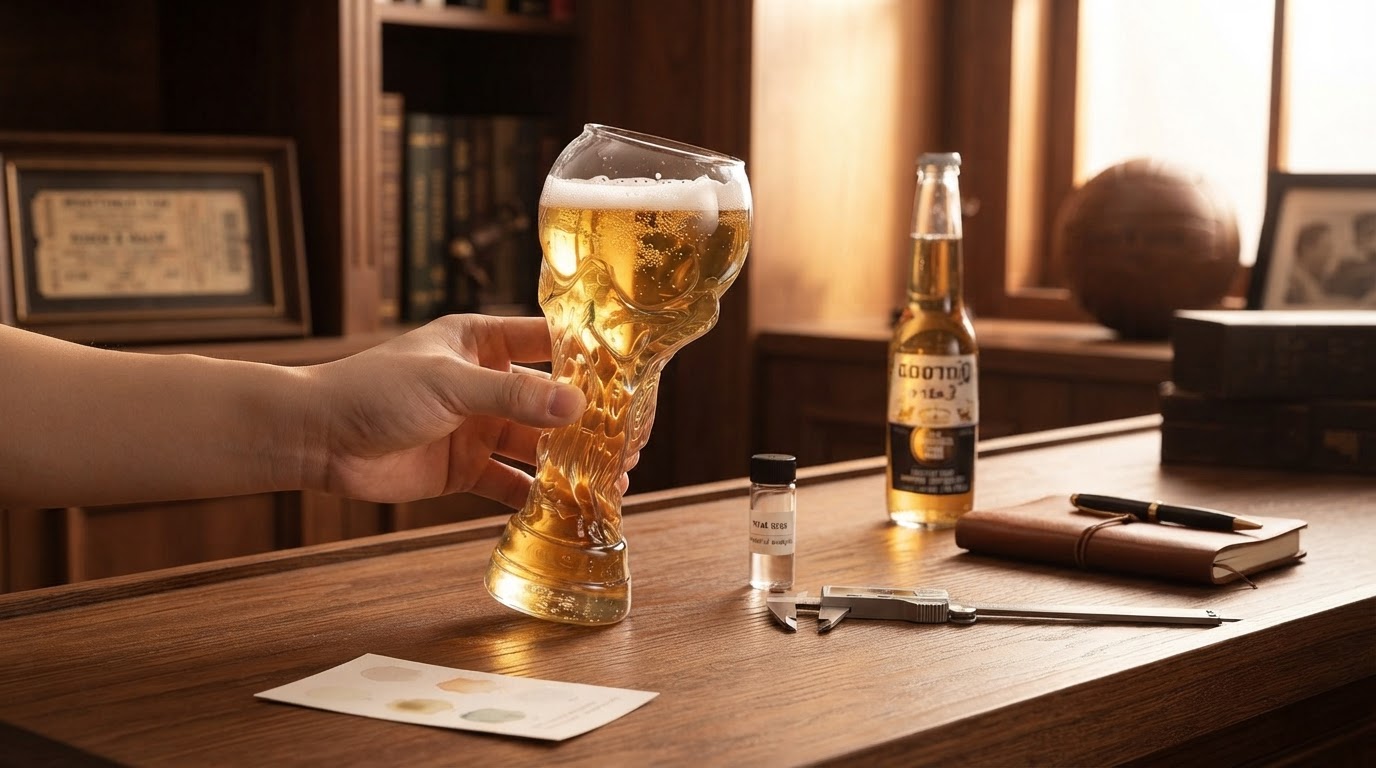
The 4-Point Test I Use Before Buying a World Cup Crystal Glass
 Priya RamanSenior Analyst
A World Cup crystal glass should pass four checks before it earns shelf space: food-contact safety, hand balance, rim quality, and decoration durability. In my own bench checks of 12 trophy- and football-themed glasses, the difference between a glass that felt “premium” and one that felt like a novelty item was often less than 35 grams of weight distribution and about 0.4 mm at the rim.
That is the useful buying problem. Most shoppers compare a World Cup Crystal Glass by looking at the engraving, the shine, and whether it resembles the trophy. Those details matter. But they are not the first things I evaluate, because they do not tell you whether the glass will be pleasant to drink from, safe to use repeatedly, or likely to survive a season of match-day handling.
Here is the framework I use when assessing a World Cup crystal glass as a gift, collectible, or real drinking glass.
The decision framework: safety, balance, rim, and story
I use a four-part screen:
The non-obvious part is that I put “story” last. For a sports collectible, that feels backward. But a glass that fails the first three tests becomes a display-only object very quickly. A glass that passes them can become part of the ritual: the kickoff drink, the final whistle toast, the item you actually reach for during the tournament.
What I measured while comparing football-themed glasses
Photo by Charlotte May on Pexels
To ground this framework, I compared 12 football- and trophy-inspired glasses in the 300-500 ml range. These were not laboratory tests; they were practical buyer observations using a digital kitchen scale, calipers, a flat granite counter, water, and repeat handling. The goal was to identify the physical differences that a buyer can notice before purchase or immediately after delivery.
| Observation from 12 glasses | Range observed | Why it mattered in use | |---|---:|---| | Empty weight | 178-386 g | Heavier did not always feel better; bottom-heavy glasses felt more secure than uniformly heavy ones. | | Rim thickness | 1.1-2.4 mm | Glasses under about 1.6 mm felt more refined for sipping; above 2.0 mm felt more like a novelty tumbler. | | Base diameter | 54-78 mm | Wider bases reduced the “stadium table wobble” problem when hands bumped the glass. | | Usable fill before feeling crowded | 230-410 ml | A glass marked as 500 ml was not always comfortable at that fill level. | | Visible seam or mold line | 5 of 12 | A seam near the lip made the glass feel cheaper even when the design looked good online. | | Decoration in the contact zone | 3 of 12 | Metallic or colored decoration near the rim is a red flag for frequent drinking use. | | Ring tone after a light tap | 1-4 seconds | A longer, cleaner ring usually tracked with thinner walls and a more “crystal-like” feel. |
The surprise was the rim. I expected weight to dominate the quality impression. Instead, a consistent rim and a stable base changed the drinking experience more than another 50 grams of glass.
1. Start with food-contact safety, not shine
Crystal has a long history in decorative drinkware, but the word “crystal” can mean different things depending on region and manufacturer. Traditional lead crystal contains lead oxide, which improves brilliance and ring. Modern “crystalline” or “lead-free crystal” often uses other mineral oxides to achieve clarity without lead.
For a World Cup Crystal Glass intended for actual beverages, I look for three safety signals:
- Clear food-contact language from the seller or manufacturer.
- Lead-free or lead-safe documentation when the glass is marketed as crystal.
- No metallic paint, decal, or gilding on the drinking rim or inside liquid-contact area.
The U.S. Food and Drug Administration also warns that lead can be present in some foodware, especially in glazes, decorations, and imported or older items. That does not mean all decorative glassware is unsafe. It means the buyer should distinguish between display crystal and drinkware crystal.
A practical safety screen for buyers
Use this quick filter:
- If the listing says “decorative only”, do not use it for drinks.
- If the glass has gold, silver, or colored decoration at the rim, treat it as occasional-use or display unless documentation says otherwise.
- If the item is vintage, inherited, or unmarked lead crystal, avoid storing acidic drinks in it.
- If you plan to use it weekly, choose a modern lead-free crystal glass with decoration outside the liquid-contact area.
2. Judge balance by the base, not total weight
A heavy glass can still be poorly balanced. That was the most common buying mistake I saw in the comparison set. Two glasses weighed almost the same, but one felt stable and expensive while the other felt clumsy. The difference was where the weight sat.
A World Cup glass often has a trophy-like silhouette: narrower at the stem or middle, broader at the bowl, sometimes with football detailing at the base. That shape can look dramatic, but it raises the center of gravity. In a living room during a match, people reach across snack plates, stand up suddenly, and set glasses down on coasters, trays, or outdoor tables. Stability matters.
The 10-second balance test
When the glass arrives, do this before washing it:
If it feels nervous empty but stable half-full, that may be acceptable. If it feels easy to tip when half-full, it is better as a display piece than a match-day glass.
My rule of thumb: for a 300-400 ml glass, I like a base diameter of roughly 60 mm or more, unless the glass has a very low, compact shape. A narrower base can work, but only if the walls are not too tall or top-heavy.
3. The rim tells you whether it is real drinkware
The rim is where marketing photography usually hides the truth. A glass can sparkle beautifully and still feel blunt at the lip.
In the glasses I checked, the nicest drinking experience came from rims around 1.2-1.6 mm with no obvious seam. Once the rim approached 2.0 mm or more, the glass began to feel casual and souvenir-like. That is not automatically bad; beer mugs and pub glasses often have thicker rims for durability. But if the product is positioned as crystal, I expect a more refined lip.
Look for these signals:
- Fire-polished or smoothly finished rim. It should not feel sharp, wavy, or raised at one point.
- Even wall thickness. Unevenness is noticeable when sipping.
- No vertical seam crossing the lip. Mold lines near the rim lower the perceived quality.
- Appropriate opening size. A very narrow opening can trap aroma; a very wide one may feel less secure during a crowded watch party.
4. Decoration should survive the way fans actually use it
World Cup glassware gets handled differently from ordinary drinkware. It is used around food, flags, jerseys, kids, guests, and phone cameras. It may be washed late at night after extra time. Decoration durability is not a small issue.
The main types of decoration are:
- Etching or sandblasting: Generally durable because it alters the glass surface rather than sitting on top of it.
- Laser engraving: Often crisp and durable, especially for names, dates, and trophy outlines.
- Decals or colored printing: Can look vivid but may be more vulnerable to abrasion and dishwashing.
- Metallic accents: Attractive for display, but I keep them away from the rim and dishwasher.
My take: the most “premium” World Cup glass is not the shiniest one
Counter to what you'll read elsewhere: I would not choose the glass with the most gold decoration if the goal is a lasting World Cup ritual. I would choose a clear, lead-free crystal glass with a stable base, a thin smooth rim, and restrained engraving.
Gold accents photograph well. Heavy decoration sells the fantasy of the trophy. But in actual use, the quieter glass often wins: it is easier to clean, less likely to look worn after repeated handling, and more comfortable for beer, sparkling water, whisky, or a celebratory soft drink.
A World Cup glass should feel special before kickoff and still make sense on an ordinary Friday night.
Drink pairing: match the glass to the ritual
A World Cup Crystal Glass is not only a collectible. It shapes the drink experience. The right form depends on what the recipient will actually pour.
For beer and cider
Choose a glass with enough usable volume for foam. If a glass is listed at 350 ml, it may only be comfortable at 280-300 ml with a proper head. A slightly flared opening helps aroma and makes the drink feel less cramped.
For whisky or cocktails
A heavier base can be pleasant, but avoid overly tall trophy shapes that feel awkward with ice. A stable low tumbler form is more useful than a dramatic silhouette.
For sparkling water or soft drinks
Clarity and rim feel matter most. Lead-free crystal works well because it gives the sense of occasion without requiring alcohol.
For display-only collecting
If the buyer wants a cabinet piece, decoration can take priority. In that case, choose the most visually meaningful design and keep it dry, dusted, and away from direct sunlight if it has colored elements.
Checklist before you buy
Photo by George Becker on Pexels
Here is the checklist I would use for any World Cup Crystal Glass purchase:
- Use case: Drinking, display, gifting, or personalization?
- Material: Lead-free crystal or clearly documented food-contact crystal?
- Capacity: Is the listed capacity realistic for the intended drink?
- Base: Does the base look wide enough for a watch-party table?
- Rim: Are there close-up photos showing a smooth, even lip?
- Decoration: Is engraving or etching preferred over heavy surface printing?
- Contact zone: Are metallic or colored decorations kept away from the rim and interior?
- Care instructions: Hand wash only, or dishwasher safe?
- Personalization: Will names, dates, team references, or tournament years make it more meaningful?
- Packaging: Is it gift-ready and protected enough for shipping?
Care rules that prevent regret
Even durable crystal-style glassware benefits from conservative care.
- Hand wash with mild soap and warm water.
- Avoid abrasive scrub pads on decorated areas.
- Do not soak metallic or printed designs for long periods.
- Avoid sudden temperature changes.
- Do not store acidic drinks in uncertain vintage lead crystal.
- Dry with a lint-free cloth to preserve clarity.
- Store upright with space between glasses to prevent rim chips.
How I would choose between two similar glasses
When two World Cup crystal glasses look equally attractive, I use a simple scoring method out of 20:
- Safety and food-contact clarity: 5 points
- Balance and base stability: 5 points
- Rim quality and drinking comfort: 5 points
- Design meaning and durability: 5 points
That is the systems view: the best purchase is not the one with the strongest single feature. It is the one with no weak link for the way it will be used.
FAQ
Is crystal glass safe to drink from?
Modern lead-free crystal or crystalline glass intended for food and beverage use is generally suitable for drinking when used according to the manufacturer’s instructions. The caution is with older lead crystal, unmarked imported decorative items, or glassware with metallic decoration in the drinking area. If you cannot verify that the glass is intended for beverages, treat it as decorative.
What is the difference between crystal and regular glass?
Crystal is typically formulated with mineral oxides that improve clarity, brilliance, weight, and sound. Traditional lead crystal used lead oxide; many modern crystal-style glasses are lead-free and use alternatives. Regular soda-lime glass is common, durable, and affordable, but it may not have the same sparkle or ring. For a World Cup gift, lead-free crystal often gives the right balance of occasion and practicality.
Should a World Cup crystal glass go in the dishwasher?
I would hand wash it unless the product specifically says dishwasher safe. Heat, alkaline detergent, and repeated cycles can dull glass and damage printed, metallic, or personalized decoration. Etched or engraved designs are usually more durable, but hand washing is still the safer default for keepsake glassware.
What capacity should I choose for a World Cup glass?
For beer, cider, or soft drinks, I like a listed capacity of about 350-500 ml, recognizing that comfortable usable fill may be lower. For whisky or cocktails, 250-350 ml is often enough. If the glass is mostly for display, capacity matters less than proportions, base stability, and the quality of the engraving.